
Packing cubes: who they help, who they don’t
Packing cubes organize clothes but also take up room. Learn when they help, when to skip them, and which sizes belong in your bag.

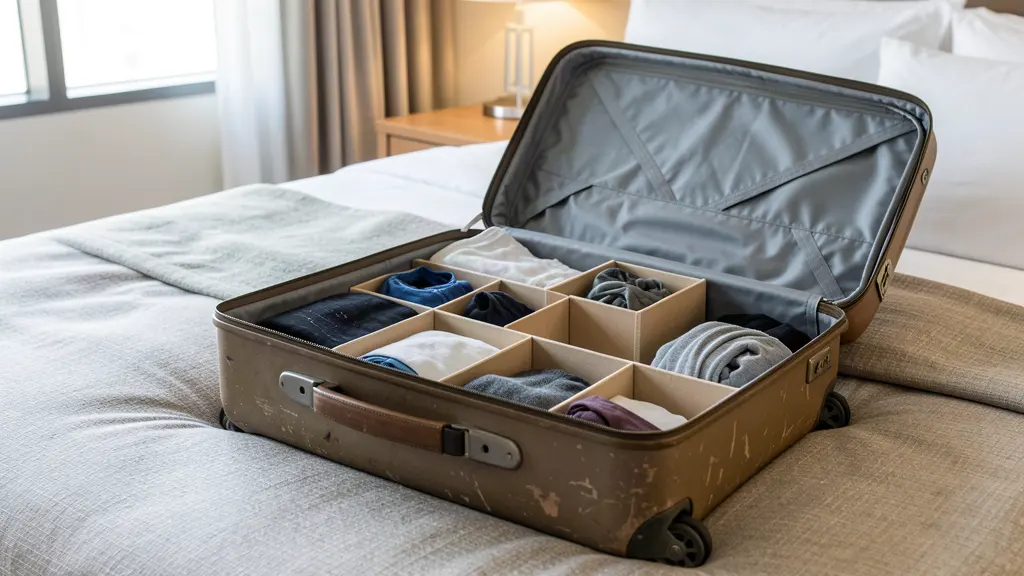
Packing cubes are fabric containers that divide a bag into sections. They keep clothing groups together and let you remove one section without disturbing the rest.
That is their main job: organization.
A standard cube does not provide meaningful compression. It holds clothes in a tidy block, but its fabric, seams, zipper, and shape also take up room. A compression cube can remove some trapped air from soft clothing. It does not reduce weight.
The useful question is whether the organization is worth the volume in the bag you plan to carry.
What a packing cube actually does
A cube keeps a category of items together. You can move it from a suitcase to a hotel drawer, then return it to the bag when you leave.
It can also limit overpacking. When the clothing cube is full, stop adding clothes. Filling six cubes and forcing all six into the suitcase does not solve the problem.
Organization and compression are different functions:
- A standard cube sorts and contains.
- A compression cube adds a second zipper that reduces the depth of soft contents.
- A stuff sack contains items but does not keep a flat shape.
- A zip pouch holds cables, medicine, and other small gear.
Do not assume that every packing cube saves space. Most standard cubes do not.
Who should buy packing cubes
People sharing one bag
A shared checked bag becomes difficult when two people’s clothes are mixed together. Use one cube per person, or use separate colors.
Travelers moving from hotel to hotel
Cubes reduce repeated unpacking. Remove the clothing cube, place it in a drawer or on a shelf, and return it to the bag when you leave. This matters more on a trip with several stops than on a weekend in one hotel.
Travelers managing clean and dirty clothes
A cube gives clean clothing a fixed place while worn items move into a laundry bag or a divided cube. Do not seal damp clothing in a solid cube for several days. Let it dry first.
Families packing by category
A small cube can hold a child’s sleepwear or swim gear. A medium cube can hold the main clothing load. Packing by category is usually simpler than using one cube for each outfit.
Who should skip packing cubes
Anyone with a personal item that is already full
A cube costs volume. Its rectangular shape can create empty gaps beside shoes, a bottle, a camera, or the curved edge of a backpack. Loose clothing can wrap around hard items and fill narrow spaces better.
Ultralight travelers
A cube adds weight and volume. A light stuff sack or laundry bag can be enough when minimum pack weight is the main goal.
One-bag weekend travelers
For two shirts, underwear, socks, and spare pants, a cube may add a step without adding much control. A cable pouch and a separate liquids bag usually do more useful work on a short trip.
Personal item versus checked bag
In a personal item
Use no more than one clothing cube unless the bag has a large, open main compartment. Choose a cube that fits the bag’s actual width and depth, not one that happens to come in a set.
A soft, partly filled cube can adapt to the bag. An overfilled cube becomes a firm block that may fit poorly around a laptop sleeve, bottle pocket, or bag frame.
Slim cubes can fill narrow channels in some wheeled bags, as shown in our Eagle Creek Pack-It Slim Cube Set review. Measure the space before buying one.
In a checked bag
Cubes make more sense when the suitcase has room for several broad, flat sections. Two or three can keep clothes stable and make the bag easier to open without loose items moving.
The volume cost still exists, but it matters less when the bag is not near its capacity limit. Weight may become the larger limit. Compression creates room. It does not change the airline’s weight limit.
How many cubes, and what sizes
Do not start with an eight-piece set.
For most trips, use:
- One medium cube for shirts, underwear, and light clothing.
- One small cube for socks, sleepwear, or another person’s clothing.
- One laundry bag, which does not need to be a cube.
Add another medium cube only when it has a clear job, such as cold-weather layers or a second traveler’s clothes.
Large cubes often duplicate the suitcase’s main compartment. Too many small cubes turn one bag into a filing cabinet.
The Eagle Creek Pack-It cube set review shows the common small, medium, and large format. It is an example, not a rule that all three sizes belong on every trip.
Compression cubes: when the zipper fight is worth it
A compression cube has a second zipper around its edge. Close the main zipper, then close the compression zipper to reduce the cube’s depth.
Compression works best with soft items that hold air:
- Underwear and socks
- T-shirts
- Knit layers
- Sleepwear
- Soft laundry
It is less useful for jeans, structured jackets, dress shirts, or clothing that wrinkles easily. These items lose little volume or become a dense, creased block.
The extra zipper is useful when one compressed cube makes a specific item fit, such as shoes at the end of the bag. It is not useful when every cube must be forced shut so that you can add clothes you do not need.
Hold clothing away from the zipper as you close it. Stop if the teeth are under heavy strain.
Eagle Creek’s current Isolate compression cube is an example of the size change, not a winner: the small cube is listed at 3 liters uncompressed and 1 liter compressed, and it weighs 1.9 ounces. See the manufacturer spec. For a product-specific look at the older design, see our Eagle Creek compression packing cube review.
Mesh versus solid fabric
Mesh-top cubes
Mesh lets you see the contents and gives dry clothing some air movement. It can catch on hooks, buckles, and rough gear.
A cheap no-name mesh set can do the same basic sorting job as a branded set. Check the zipper, seam binding, and empty weight. The logo does not change the function.
Solid cubes
Solid fabric hides the contents and contains loose threads, dust, and some odor better than mesh. It can also trap moisture and make each cube harder to identify.
Solid does not mean waterproof. Unless the manufacturer states that the construction is sealed, treat it as a fabric organizer, not a dry bag.
Our Boundary hemp packing cube review is an example of a cube built around a different fabric choice. Decide whether the material serves a packing need before paying for it.
Packing cubes versus stuff sacks and zip pouches
Use a packing cube for folded or rolled clothing in a suitcase or clamshell backpack. It gives fast access and keeps a flat shape.
Use a stuff sack for soft items in a top-loading pack or an irregular space. It fills corners better, but you may need to empty it to reach the bottom.
Use a zip pouch for cables, chargers, medicine, and small toiletries. These items need pockets or loops more than a large clothing compartment.
A dry bag has a separate job. It protects contents from water when closed correctly. Do not treat every solid packing cube as a dry bag.
A divided cube is useful when you want clean and dirty clothes in one container. Peak Design’s packing cube is one current example of an internal clean-and-dirty divider. A separate laundry bag still does that job with less hardware.
What not to buy
Skip novelty prints when the print is the main feature. A pattern can identify one person’s cube, but it does not fix a weak zipper or heavy construction.
Skip one-size systems. Bags have different shapes, and clothing loads change by trip.
Skip sets with shoe bags, cosmetic bags, sacks, and tiny pouches that have no planned job. Count useful containers, not package pieces.
Skip cubes with thick fabric, rigid panels, large handles, or oversized zippers when the empty cube weighs more than the light clothing it will hold.
The cubes must fit the luggage. Do not redesign the bag around the cube set.
A packing method that takes a few minutes
Clothes: Put the main clothing load in one medium cube. Fold or roll based on the garment. Do not force every item into a roll.
Dirty clothes: Pack one empty laundry bag. Move worn clothes into it during the trip. Use a divided cube only when you need clean and dirty items in one container.
Liquids: Keep liquids in a separate leak-resistant pouch. Place it where you can remove it without opening the clothing cube.
Cables: Use one small zip pouch. Keep adapters and short cables together. Place large chargers outside the pouch when they fit the bag better there.
Put the clothing cube in the main flat area. Fit shoes, a jacket, and hard items around it. If the bag zipper is under strain, remove an item instead of adding another compression step.
Packing cubes help when they reduce repeated unpacking, separate people or clothing states, and make a large bag easier to manage.
They do not help when the bag is already at its volume or weight limit and loose clothing would fit better.
Start with one medium cube and one small cube. Keep each cube that solves a clear problem. Leave the rest at home.
FAQ
Do packing cubes save space?
Standard cubes usually organize rather than save space. Compression cubes can reduce trapped air in soft clothing, but they add fabric and zipper volume. Neither type reduces weight.
Is it better to roll or fold clothes?
Use the method that suits the garment. Roll soft items when that makes them easier to place. Fold shirts, pants, and wrinkle-prone clothing when a flat stack works better.
Can packing cubes fit in a personal item?
Yes, but one cube is often enough. Test it inside the loaded bag. A cube that fits an empty backpack may not fit after you add a laptop, liquids, shoes, and cables.
How do I separate clean and dirty clothes?
Carry a light laundry bag, or use a cube with two compartments. Do not pack several empty cubes only for future laundry.
Are compression cubes bad for clothes?
They can wrinkle stiff or carefully folded garments. Use them for soft items and laundry. Do not force the compression zipper when clothing is caught in the edge.