
Power bank airline rules: 100Wh, 160Wh, and what TSA actually cares about
Airline power bank rules explained: carry-on only, 100Wh and 160Wh limits, label math, airline approval, and security screening.

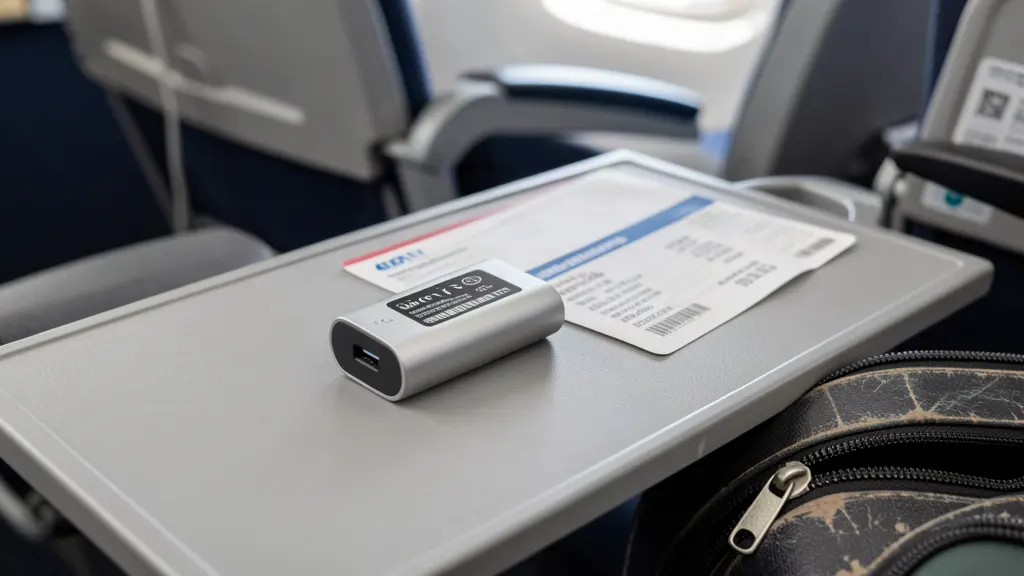
Airlines treat a power bank as a spare lithium battery. That classification matters more than the brand, port count, or charging speed.
The basic US rule is simple. Put the power bank in your carry-on. Do not put it in checked baggage. A battery rated at 100 watt-hours, or Wh, or less is generally allowed. A battery from 101Wh through 160Wh needs airline approval. The federal limit is two spare batteries in that range, but an airline can allow fewer. A battery above 160Wh is not allowed in ordinary passenger baggage. The FAA battery guide and the TSA power-bank page state the core rules.
The rule table
- 0–100Wh: carry-on yes, checked bag no, airline approval usually not required
- 101–160Wh: carry-on yes, checked bag no, airline approval required
- More than 160Wh: not allowed as an ordinary spare power bank
Exactly 100Wh is in the first category. Exactly 160Wh is at the top of the approval category. Those bounds match the FAA’s 0–100 and 101–160 split.
The FAA has no federal quantity limit for rechargeable batteries at or below 100Wh when they are for personal use. Airlines can set lower limits. From 101Wh through 160Wh, the federal maximum is two spares per person, with airline approval. A carrier can approve one or two, or refuse them.
This guide covers ordinary power banks and portable chargers. Mobility-device batteries have separate rules.
Carry-on means the battery stays with you
A power bank cannot stay in a bag that goes into the hold. This includes a carry-on that an agent checks at the gate. Remove the bank before you hand over the bag and keep it in the cabin.
The FAA also requires protection from damage and short circuit. Keep the pack in a pouch or separate pocket. Do not place exposed contacts against keys, coins, or another loose battery. The original package, a battery case, a pouch, or nonmetallic tape over exposed terminals can provide protection.
Do not fly with a swollen, punctured, damaged, defective, or recalled pack. See the FAA PackSafe lithium battery page.
What TSA actually controls
TSA screens the item at the checkpoint. The FAA and the US Department of Transportation set the hazardous-material rules. The airline approves batteries above 100Wh and can impose stricter limits.
TSA’s published instruction is direct: carry-on yes, checked bag no. TSA also states that the final checkpoint decision rests with the officer. TSA does not provide the airline approval needed for a pack above 100Wh. Get that approval from the operating airline before travel. Ask what proof the airline requires and keep its response with your booking information.
A clear capacity label helps. A large pack with no readable rating gives the officer and airline less information to use.
How to read the power-bank label
Look for Wh, watt-hours, or rated energy. If the pack says 74Wh, no calculation is needed.
If the label gives volts and amp-hours, use:
Wh = V × Ah
If it gives milliamp-hours, use:
Wh = V × mAh ÷ 1,000
The FAA gives this calculation.
For a pack whose stated capacity uses 3.7V:
- 10,000mAh = 37Wh
- 20,000mAh = 74Wh
- 27,000mAh = 99.9Wh
- 30,000mAh = 111Wh
Use the voltage tied to the stated battery capacity. Do not automatically use the USB output voltage. A label may show a 5V, 9V, or 20V output while the internal capacity uses another nominal voltage. American Airlines prints a shortcut of `Wh = mAh × 3.7 / 1,000`. That is their example, not a substitute for the voltage on your pack.
What if the pack lists only mAh?
Check the other side, the base, the manual, or the manufacturer’s page for Wh or nominal battery voltage.
If the manufacturer states that the capacity uses 3.7V, use the formula above. If you have only mAh and no voltage, you cannot calculate Wh with confidence. Carry a pack with a readable Wh label, or bring the manufacturer’s specification for the exact model.
Spare battery versus battery installed in a device
A laptop, phone, camera, or tablet has a battery installed in the device. The FAA permits many such devices in carry-on or checked baggage within the size limits, although carry-on is preferred. In checked baggage, the device must be fully powered off and protected from accidental activation and damage.
A power bank is different. Its purpose is to supply energy to another device, so the FAA treats it as a spare battery. Switching it off does not change that. Charging cases and external battery chargers also follow the spare-battery rule. They must stay in the cabin.
Power banks with a built-in AC plug
Some compact chargers combine folding wall prongs, USB ports, and an internal battery. Treat the unit as a power bank: carry-on only, same Wh limits. An AC input plug does not make the battery installed in a phone or laptop. The FAA includes external battery chargers and portable rechargers in its spare-battery guidance.
Power stations and the unclear boundary
A unit with an AC output socket, inverter, display, handle, or solar-generator branding may be sold as a portable power station.
The FAA now names power stations in its passenger guidance. Its power-station notice says units above 160Wh are forbidden on passenger aircraft and units under 160Wh must remain in the cabin. The broader FAA rule still requires airline approval above 100Wh.
I couldn’t confirm one federal definition that cleanly separates a large power bank from a power station. Airlines can also prohibit the category. American Airlines lists large portable power sources and lithium-ion generators as not allowed.
If the unit has an AC output socket or looks like a small generator, ask the operating airline about the exact model before travel.
Airline rules can be stricter
Carrier rules can change the quantity, permitted size, storage location, and in-flight use. These examples were checked on August 22–23, 2026. American’s page was confirmed from a 19 August 2026 archive of the live restricted-items page.
American Airlines: Its dedicated power-bank section limits passengers to two portable chargers, each no more than 100Wh. Do not store them in overhead bins. Do not recharge them from a seat power outlet. Keep them visible and accessible, such as under the seat or in the seatback pocket.
American’s broader lithium-battery table separately lists up to four spare batteries under 100Wh, and up to two spares from 100Wh to 160Wh. I couldn’t confirm from the page whether American will approve a *power bank* in that larger range. Follow the dedicated power-bank limit unless the airline confirms otherwise. See American’s restricted items page.
Delta Air Lines: Delta permits no more than two spare batteries above 100Wh through 160Wh and sets a maximum of 20 spares in total. Power banks should remain accessible under the seat or in the seatback pocket, not in the overhead bin. Do not recharge a power bank from in-flight power. Delta also says not to use a spare battery to charge a device during taxi, takeoff, or landing. See Delta’s battery page.
JetBlue: JetBlue limits passengers to two power banks. They cannot go in checked baggage or overhead compartments. They must not be charged from seat power. JetBlue says they should not charge another device during the flight. Its non-mobility battery limit is 100Wh. See JetBlue’s battery page.
Check the airline that operates each flight, including a codeshare segment.
Will I get this taken at security?
A sound, clearly marked power bank at or below 100Wh, packed in carry-on, is within the federal baseline. That does not guarantee passage. TSA gives the officer the final checkpoint decision, and the airline can apply a stricter rule.
Clear reasons for rejection include a pack that:
- is in checked baggage
- is swollen, damaged, defective, or recalled
- is above 160Wh
- is above 100Wh without airline approval
- has exposed terminals
- exceeds the carrier’s quantity or product-category limit
A pack with no readable rating or model documentation may also cause a problem because its capacity cannot be confirmed quickly.
Do not expect the checkpoint to resolve an airline-policy question. Confirm batteries above 100Wh and power-station models before departure.
Choosing a pack for air travel
For the least paperwork, choose a pack with a clear Wh marking and a rating no higher than 100Wh. A 20,000mAh pack rated at 3.7V is about 74Wh.
For product choices, see Practical Travel Gear’s guide to the best travel power banks for flights and long travel days. This page covers the rules, not the product roundup.
FAQ
Can a power bank go in checked luggage?
No. Spare lithium batteries, including power banks and portable chargers, must go in carry-on baggage. Remove them if your carry-on is gate-checked.
Is a 20,000mAh power bank allowed on a plane?
Usually, but check the label. At a stated 3.7V, 20,000mAh equals 74Wh, which is below 100Wh. The airline can still set a quantity or use restriction.
Can I take two power banks?
The federal rule has no quantity limit for personal-use rechargeable batteries at or below 100Wh, but airlines can set one. American and JetBlue currently limit power banks to two per passenger.
Can I use a power bank during the flight?
It depends on the carrier. Some require the pack to remain visible and accessible. Some prohibit charging the bank from seat power. JetBlue says power banks should not charge other devices during flight. Delta restricts use during taxi, takeoff, and landing. Follow the operating airline’s rule and the cabin crew’s instructions.
Does the Wh rating have to be printed on the pack?
The FAA says the Wh rating should be marked and gives a formula when it is not. A clear manufacturer label is the simplest proof. If the pack lists only mAh and no voltage, bring exact manufacturer documentation or use a different pack.